
What Is a Heating Coil? Working Principle and Heat Exchanger Differences
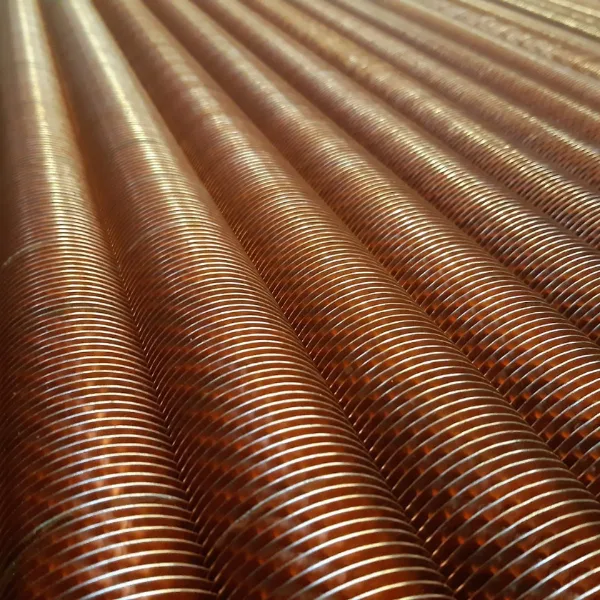
A heating coil is a tube arrangement that transfers heat carried by a fluid to another medium through the tube surface. In industrial facilities, coils heat air, cool liquids or control process temperatures. Tubes can form a bent coil, a straight bundle or a finned assembly. Describing a coil only as a spiral tube therefore leaves out many industrial designs.
In a drying line, steam can pass inside the tubes while air flows over the outside. Heat reaches the air without the two media mixing. Depending on the application, the same basic approach can use hot water or another heat transfer fluid.
How does a heating coil work?
Heat transfer requires a temperature difference between the fluid inside the tube and the medium outside. Heat flows from the hotter side to the colder side. The internal fluid, tube wall and external medium must be considered together; tube length alone does not explain the unit’s capacity.
Fins added to the outside of the tube increase the heat transfer area on the air side. This is particularly useful in air heaters. However, adding more fins does not improve every application. Airflow, fouling and access for cleaning also belong in the design. HEATMEK’s finned tube solutions address these needs through different manufacturing methods.
Is a coil the same as a heat exchanger?
Heat exchanger is the general term for equipment that transfers heat between two media. A coil describes a tube arrangement used within such equipment or as a unit in its own right. Not every heat exchanger has a coil configuration. Plate heat exchangers transfer heat through plates, while shell and tube units contain a tube bundle inside a shell.
When requesting equipment, explain which fluid will be heated or cooled rather than simply asking for a heat exchanger. Air heating, water-to-water heat transfer and steam process heating may require different mechanical arrangements.
Where are industrial coils used?
- Drying lines: Preparing hot air for textile, food, paper and timber processes.
- Air heating: Bringing air in ducts and chambers to the required process temperature.
- Cooling: Removing heat with an appropriate fluid and surface design.
- Heat recovery: Using waste heat through a suitable tube arrangement.
What information is needed for selection?
Start with fluid inlet temperatures, target outlet temperatures, flow rates and operating pressures. For air-side applications, also provide the airflow, existing fan information and allowable pressure drop. Installation dimensions, connection positions and maintenance clearance directly affect selection.
Condensate removal needs separate assessment in steam systems. Increasing the surface area of a unit with a drainage problem may leave the underlying issue unresolved. Material choice also deserves attention; read our copper and stainless steel coil comparison.
Frequently asked questions
Does every coil have fins?
No. Bare-tube coils and other tube geometries are also used. The choice of fins depends on the external medium and the required heat transfer.
Are coils only used for heating?
No. The temperature difference determines the direction of heat flow. A suitable design and working fluid also allow cooling applications.
HEATMEK provides industrial coil design and manufacturing. Send us your fluid, temperature and capacity data for a technical review.
Technical reading: Spirax Sarco — Heating with Coils and Jackets.